.png)
.png)
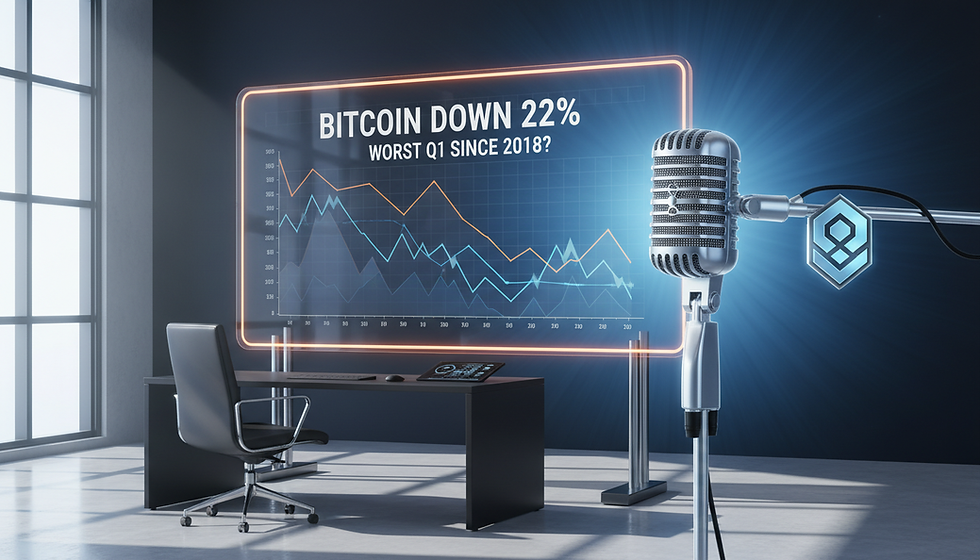
Bitcoin down 22%, could it be the worst Q1 since 2018?
- Feb 17
- 8 min read
Overview of Bitcoin's Current Performance
Red candles stack. Stop-losses trip. Portfolios sag by a fifth. That’s the gut-check behind a 22% slide from New Year levels as of mid‑February 2026—an early-quarter drawdown big enough to raise a hard question: is this shaping up to be Bitcoin’s worst Q1 since 2018, and what does that say about Bitcoin Q1 performance when the year opens this cold?
Put numbers on it. If you started January 1 with a $10,000 Bitcoin allocation, you’re staring at roughly $2,200 in paper losses in just a few weeks. That’s rent money. It also compresses risk budgets for the rest of Q1 because every new dip bites a larger percentage of what’s left. Q1 matters more than most realize: it often sets the psychological tone for the year. When the first inning goes poorly, coaches get conservative. Traders do the same, especially when Bitcoin Q1 performance frames the narrative for risk-taking.
Against the historical tape, this 22% pullback isn’t 2018-bad (that quarter was closer to a 50% slide), but it’s meaningfully worse than most first quarters since. In community channels, the tone has shifted fast: from “new highs soon” to “wake me at support.” Derivatives desks report choppier funding and wider spreads. On exchanges, we see a familiar rhythm in the Bitcoin price: risk-off, bounce, lower high, and sideways purgatory that tests patience.
One example among many: as a Platform/Service in digital asset management and payments, Coca Wallet hears users ask for two things during weeks like these—alerts that trigger before pain becomes panic, and clearer context on what a quarter like this usually means. That context is the critical piece. Without it, every wick looks catastrophic. With it, you can rank the current move on a scale you trust and judge Bitcoin Q1 performance against history instead of headlines.
🔑 Key Takeaway: Understanding Bitcoin’s historical context is crucial for evaluating its current performance.
With the immediate picture in view, it helps to step back and ask: how does this Q1 stack up against Bitcoin’s past opening quarters, and where does Bitcoin Q1 performance typically land when macro headwinds bite early?
Historical Performance Analysis of Bitcoin in Q1
Bitcoin’s first quarters have a habit of bookending narratives. Q1 2018 marked the transition from euphoria to bear market. Q1 2021, in contrast, put rocket fuel under a breakout year. The pattern isn’t random; Q1 carries post-holiday liquidity quirks, early-year fund positioning, and tax-planning effects that tend to magnify swings—factors that consistently color Bitcoin Q1 performance.
Think of Q1 like the year’s first scouting report. It doesn’t tell you the final score, but it does reveal the other team’s playbook—how liquidity reacts to shocks, how fast momentum builds or dies, whether buyers defend pullbacks or step aside. Across recent years, two tendencies stand out: extremes often cluster at turning points, and mild Q1s tend to precede range-bound years in Bitcoin price action.
Here’s a concise, rounded look at Q1 outcomes from 2018 through 2023. Numbers are approximate to keep focus on the signal rather than month-end noise:
Year | Q1 Performance | Notable Events | Investor Sentiment |
2018 | ~-50% | Post-2017 blowoff; retail capitulation | Fearful, defensive |
2019 | ~+10% | Early base-building after deep bear | Skeptical optimism |
2020 | ~-10% | Pandemic shock and liquidity crunch | Whipsawed, risk-averse |
2021 | ~+100% | Breakout to new highs; institutional buzz | FOMO, momentum-chasing |
2022 | ~-5% | Macro headwinds begin (rates, USD strength) | Cautious, headline-driven |
2023 | ~+70% | Rebound from late-2022 lows | Rebuilding confidence |
Two insights jump off the page. First, the “worst since 2018” threshold is steep; any Q1 flirting with a 20–30% decline is rare and usually comes at inflection points. Second, strong positive Q1s tend to feed trend-following behavior, while deep negative Q1s push traders into “wait for confirmation” mode. That behavior loop can become the market—and it’s why Bitcoin Q1 performance often sets the emotional baseline for the rest of the year.
That context frames today’s 22% dip not as an outlier, but as a possible signal that 2026 is a transition year. Is it a downshift or a reset? To answer, we need to dissect the forces pressing on price right now.
Factors Contributing to the Recent Decline
Start with the macro tape. Rising real yields and a firmer dollar (think DXY grinding higher) typically weigh on risk assets, and Bitcoin hasn’t been immune. When global liquidity tightens—even modestly—marginal buyers pull bids, and the impact compounds in assets where sentiment does as much work as cash flows. It’s like trying to fill a pool while someone quietly opens the drain. In that setup, Bitcoin Q1 performance often reflects more about liquidity and rates than about crypto-specific news.
Now the microstructure. Perpetual futures funding rates—the small fee longs pay shorts (or vice versa) to keep contracts near spot—flipped negative at points, signaling that shorts were willing to pay to stay short. That’s not destiny, but it’s an early-warning light. Add thin order books—fewer resting bids close to the market on venues like Coinbase and Binance—and you get faster air pockets. Here’s how this actually works: a wave of market sell orders (or liquidations) slams into shallow bids, prints through levels, and triggers more stops. The cascade isn’t about a single seller; it’s about the plumbing, and it’s a recurring feature of weak Bitcoin Q1 performance when leverage runs hot.
Social dynamics matter too. The narrative pivoted from “breakout continuation” to “prove it.” That phrase changes behavior. Swing traders stop buying dips and start selling rips. Long-only buyers stretch their time horizons. Miners may add incremental sell pressure when hashprice (revenue per terahash) tightens, converting more BTC to cover operations. And Q1 has a quirk: some investors raise cash for tax obligations, trimming crypto positions when volatility spikes. Add in shifting expectations around Federal Reserve policy and occasional regulatory headlines, and you’ve got the cocktail that commonly drags on Bitcoin price momentum each early year.
Before: many ignored funding, open interest, and order book depth—focusing only on price. After: the savvy track these micro signals as their weather report, especially when Bitcoin Q1 performance is already under strain.
If these forces shaped the decline, what do they tell us about how investors actually feel—and what they might do next?
Market Sentiment and Investor Behavior
Sentiment shifted from “buy the dip” to “prove support.” You can hear it in trader chats: fewer bravado calls, more conditional language—“if we reclaim X,” “if funding resets,” “if volume confirms.” That conditional mindset is a tell. It means buyers want evidence, not promises, and that mentality often defines Bitcoin Q1 performance when early drawdowns test conviction.
Behaviorally, investors tend to cluster orders at round numbers. When price hovers just above, those bids act like floorboards; crack one plank, and feet scramble to the next support. I’ve seen this pattern before: in one Telegram group last week, a dozen members posted the same line—“I’ll buy if we hit [round level].” When that level tagged, the bounce was real but short; the next day, sell orders stacked above, and the range compressed. It’s like sending two salespeople to pitch the same client—one says “call me when you’re sure,” the other says “I’ll sign now.” The indecision stretches the process and keeps the Bitcoin price boxed.
Analysts describe this regime as “wait-and-see with downside bias.” Long-term holders still sit on profits and historically don’t panic-sell early in a downdraw. Short-term holders—those who bought in the last few months—are the swing factor. If they capitulate together, Q1 can print an exaggerated low. If they distribute over weeks, you get a grinding range that feels endless. Either way, Bitcoin Q1 performance becomes a proxy for how quickly confidence rebuilds after a shock.
What does this mean for you? Expect sharp, tradeable rallies within a broader caution zone. Relief bounces don’t equal trend changes unless volume, breadth, and spot-led buying line up. The good news? Sentiment cycles turn faster than fundamentals. One strong weekly close can thaw a month of frost and reset how traders score Bitcoin Q1 performance heading into Q2.
So the mood is fragile. The practical question is what that fragility sets up for the rest of Q1—and the year that follows.
Potential Future Implications for Bitcoin
Three plausible paths sit ahead:
1) Worst-since-2018 finish. If the quarter closes below a ~-25% print, history says the rest of the year often opens with defensive positioning. That doesn’t doom the year, but it raises the hurdle for durable breakouts and would stamp a weak Bitcoin Q1 performance into the year’s narrative.
2) Late-quarter repair. A March rebound that trims losses to the mid-teens would keep the “macro headwind, crypto-specific digestion” story alive. Markets can live with that. It frames Q2 as a proving ground and recasts Bitcoin Q1 performance as a setback, not a regime change.
3) Range and rebuild. Price oscillates in a wide band, volatility compresses, and a base forms. This path frustrates both sides but often seeds the next directional move—an outcome that frequently follows middling Bitcoin Q1 performance when neither bulls nor bears can land a knockout.
Advice grounded in history, not prediction: define your guardrails now. Use closing levels, not intraday wicks, to make decisions. Pre-commit in writing to scenarios where you cut risk, add modestly, or stay flat. One approach is time-based scaling—small, scheduled buys or trims that don’t depend on perfect timing. Another is volatility budgeting—dial position size down when realized volatility (how much price actually moves, measured over time) runs hot. Framing these rules against Bitcoin Q1 performance helps keep decisions consistent when screens get loud.
Common Questions About Bitcoin’s Q1 Performance
What caused Bitcoin's recent decline?
There isn’t a single culprit. Start with macro: firmer real yields and a stronger dollar made risk assets wobble, and Bitcoin followed. Add market mechanics: negative or flipping funding rates signaled pressure from shorts, and a thin order book let sell waves travel farther than usual. Layer in behavior: sentiment cooled, many short-term holders got nervous, and some investors raised cash for near-term obligations. Regulatory worries in headlines can intensify that caution even if no new rules land. Put together, it’s a recipe for a swift 22% slide that feels larger than the calendar would suggest, the kind of setup that often drags on Bitcoin Q1 performance.
How does this Q1 compare to previous years?
On a simple scoreboard, a 22% drawdown by mid-quarter makes this one of the rougher starts since 2018’s steep fall. 2019 and 2022 were comparatively mild; 2021 and 2023 were strong out of the gate. The significance isn’t just the number—it’s the message investors take from it. Big negative Q1s tend to put markets in proof mode: buyers want reclaimed levels and healthier volume before they commit. That’s why looking at past Q1s gives you a better lens for reading today’s tape and for grading Bitcoin Q1 performance in real time.
What should investors consider moving forward?
Focus on process over prediction. Map three scenarios before they happen—deeper drawdown, range-bound chop, relief rally—and tie each to a small, pre-set action. Use end-of-week closes to reduce noise. Track a short list of micro indicators (funding, open interest, spot-led volume) as context, not as triggers. And anchor risk to a budget you can sleep with; losing sleep is a signal, not a badge of honor. Historical Q1s suggest that patience pays when the market demands proof, and that’s especially true when Bitcoin Q1 performance starts the year on its back foot.
Is Bitcoin still a viable investment?
Viable doesn’t mean easy. Bitcoin has survived bigger hits than this and has also delivered outsized gains in strong cycles. Both can be true. Whether it’s right for you depends on time horizon, risk tolerance, and how you manage drawdowns. Some investors keep a small core position and only trade around the edges; others step aside until conditions improve. The key is to decide your playbook in calm moments, then stick to it when screens turn red. One way to do that is to judge moves against your framework for Bitcoin Q1 performance rather than against daily headlines.
—
The practical side: if you’re managing your exposure day to day, set one “do this today” action—write down the two weekly closing prices that would make you either reduce or modestly add to your position, and create alerts so the decision meets you at the right time, not hours later.
From our vantage point in digital asset management and payments, our wallet app supports that discipline with configurable price alerts and recurring buys you can pause or resume—one option among many tools you might use. Use what keeps you consistent. This commentary is for education, not investment advice.
The bottom line: a 22% drop by February 17 signals a Q1 that could rank as the harshest since 2018. That raises real questions about stability and sentiment. You can’t control the tape, but you can control your tempo. Choose guardrails now. On your next login, set those alerts, define those weekly levels, and give your future self fewer panicked decisions—especially while Bitcoin Q1 performance is still writing the year’s opening chapter.


.png)
Comments